
Magical creatures abound at Yule. If you’ve been naughty (yes, you know who you are) then a good choice for your mascot this Yule is the kallikantzaros, a troublemaking impish goblin-like being in found in Southeastern European folklore. Stories about the kallikantzaros can be found in Greece, Bulgaria, Serbia, and Turkey. Kallikantzaroi are believed to dwell underground but come to the surface only during the twelve days of Christmas, from 25 December to 6 January (from the winter solstice for a fortnight during which time the sun ceases its seasonal movement). Their mischief-making nature puts the kallikantzaroi into Dionysus’ entourage — Dionysus being the resident God of Sex, Wine and a Good Time.
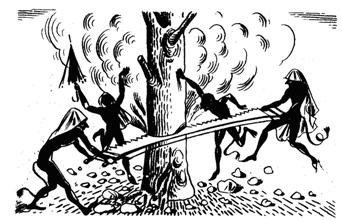
It is believed that kallikantzaroi stay underground sawing the world tree, so that it will collapse, along with earth itself. However, according to folklore, when they are about to saw the final part, Yule dawns and they are able to come to the surface. They forget the tree and come to bring trouble to mortals. Finally, on the last day of Winter Solstice season (6 January), the sun starts moving again, and they must go underground again to continue their sawing. They see that during their absence the world tree has healed itself, so they must start working all over again, and thus continues the annual cycle.
There is no standard description of the appearance of kallikantzaroi and regional variations occur. Some Greeks have imagined them with animal parts, like hairy bodies, horse legs, or boar tusks; sometimes enormous, other times diminutive. Other stories describe them as humans of small size that smell horrible. They are predominantly male, often with protruding sex characteristics. (I did tell you that the kallikantzaroi are part of Dionysus’ entourage, didn’t I? What else would you expect from a member of his entourage?) Many Greeks have imagined them as tall, black, hairy, with burning red eyes, goats’ or donkeys’ ears, monkeys’ arms, tongues that hang and heads that are huge. The most common belief is that they are small, black creatures, humanoid apart from their long black tails. The shape of the kallikantzaros is said to resemble that of a little, black devil. Often blind, kallikantzaroi are said to speak with a lisp and love to eat frogs, worms, and other small creatures.
Kallikantzaroi are believed to be creatures of the night. According to folklore, there were many ways people could protect themselves during the days when the kallikantzaroi were loose. One such method was to leave a colander on their doorstep to trick the visiting kallikantzaros. It was believed that since it could not count above two – three was believed to be a holy number, and by pronouncing it, the kallikantzaros would kill itself. The kallikantzaros would sit at the doorstep all night, counting each hole of the colander, until the sun rose and it was forced to hide. Another method of protection from kallikantzaroi was to leave the Yule log burning in the fireplace for all 12 nights so that the kallikantzaroi not enter through the fireplace. According to legend, any child born during the twelve days of Yule was in danger of transforming to a kallikantzaros during each Yule season, starting with adulthood. It was believed that the antidote to prevent this transformation was to bind the baby in tresses of garlic or straw. According to another legend, anyone born on a Saturday could see and talk with the kallikantzaroi.
When not writing about magical creatures for Ravenhawks, Kamberlyn works with clients to help them bring into their lives the relationship, career and life that their soul desires for them. She can be found on KEEN at kamberlyndivinelove, or through her website www.LadyKamberlyn.com.
 Ravenhawks' Magazine Magick for Mind Body and Soul
Reblogged this on Kate McClelland.
LikeLike
Thanks
LikeLiked by 1 person