
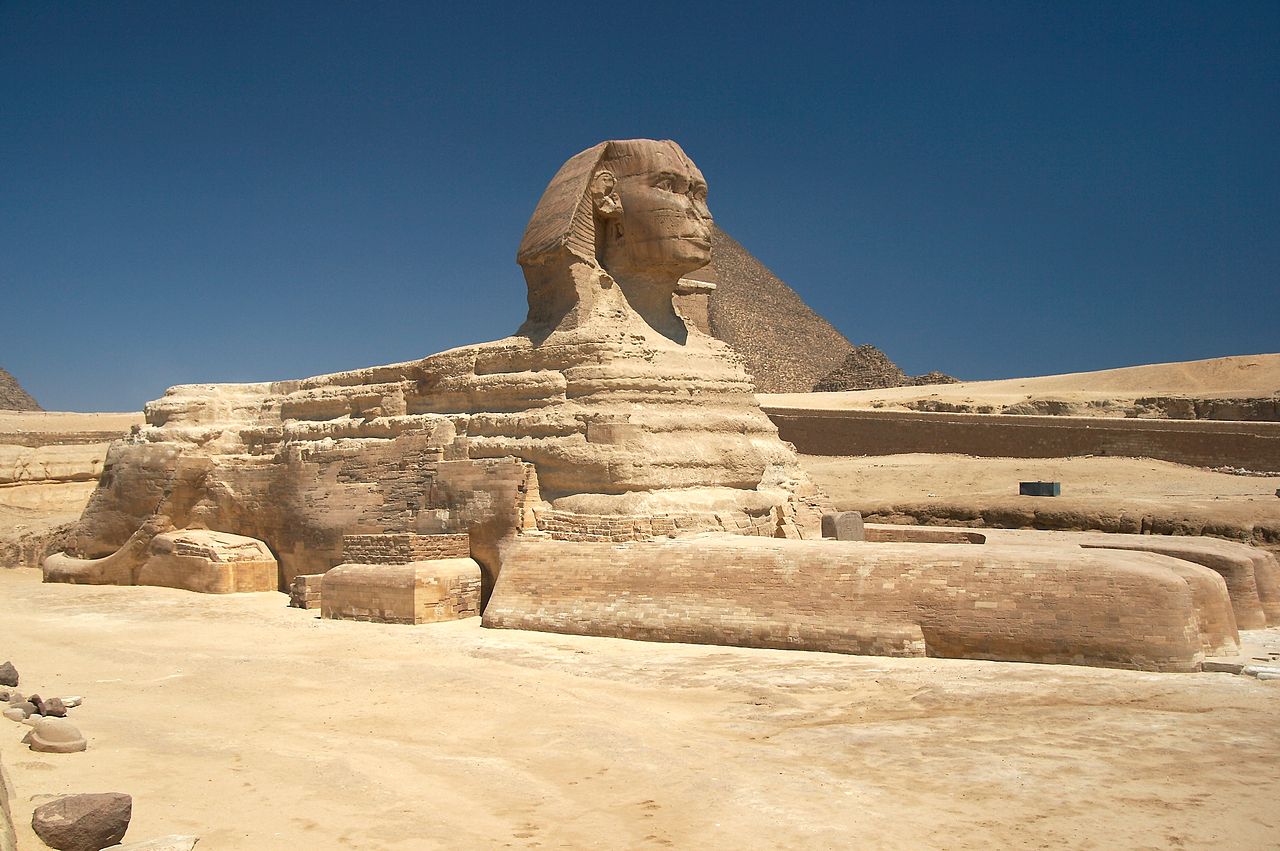
There are three types of sphinx.
- The androsphinx, the typical lion with a human face/head
- The criosphinx, a ram-headed lion.
- The hierocosphonx has the body of a lion and the head of a hawk.
When the Egyptian sphinx was portrayed as a female it symbolized Isis and/or the reigning queen. The Egyptian androsphinx is a symbol of abundance, power, wisdom, mysteries, riddles, truth, unity, and secrets. Sometimes a pair of sphinx was pictured with the tree of Life as a symbol of fertility and conception. As a solar symbol, the sphinx is often associated with the sun-god Ra; Horus in the Horizon; and Harmakhis, the Lord of the Two Horizons, who represents the rising and setting sun, rebirth, and resurrection. Androsphinx usually bear the face of the pharaoh who ordered their construction and symbolize the divine power and wisdom he used to rule and protect his people. In Greek mythology, the sphinx was portrayed quite differently: it was an unhappy monster, a symbol of the ‘terrible mother’; the monster of death-bringing extreme bad luck and the perversion of the intellect, womanhood, and power. Like many other mythological creatures, the Greek sphinx was thought to live in the Ethiopian mountains. The Assyrian sphinx looked quite different from the Egyptian one. It had a human head, wings, and the parts of a bull and a lion. Sometimes it had five legs instead of the usual four. A composite mythological being with the body of a lion and the head of a human being is present in the traditions, mythology and art of South and South-East Asia, including India, Sri Lanka, the Philipines, Myanmar and Thailand.
According to legend Hera sent the Sphinx from her Ethiopian homeland to Thebes in Greece where she asks all passersby the most famous riddle in history: “Which creature has one voice and yet becomes four-footed and two-footed and three-footed?” She strangled and devoured anyone unable to answer. Oedipus solved the riddle by answering: Man—who crawls on all fours as a baby, then walks on two feet as an adult, and then uses a walking stick in old age. By some accounts, there was a second riddle: “There are two sisters: one gives birth to the other and she, in turn, gives birth to the first. Who are the two sisters?” The answer is “day and night” (both words are feminine in Greek). Bested at last, the tale continues, the Sphinx then threw herself from her high rock and died.
Since its form combines human and animal parts into one body, the sphinx usually symbolizes the union of mind and body or intellectual, spiritual, and physical strengths with varying results. It is also, when composed of four animals including a human, a symbol of the four elements – earth, wind, fire, and water. The Druids counted a many-breasted sphinx among their fertility and maternal symbols.
An interesting perspective on the sphinx is its role as guardian. In Giza the sphinx is aligned astrologically to suggest it guards the gateway to another realm. On the earthly plane, the sphinx guards the resting place of pharaohs and was said to guard the Temple at Delphi. There is compelling evidence that the damage to the sphinx was caused by water (as in the flood that made Noah famous) and not sand. Archaeologists have never been able to date the construction of the sphinx, but the likelihood is that the sphinx is between 8,000 and 20,000 years old. In the tarot deck, the sphinx sits atop the Wheel of Fortune, which represents the cycles of eternity, and the sphinx guards the entrance to the new cycle.
 Ravenhawks' Magazine Magick for Mind Body and Soul