
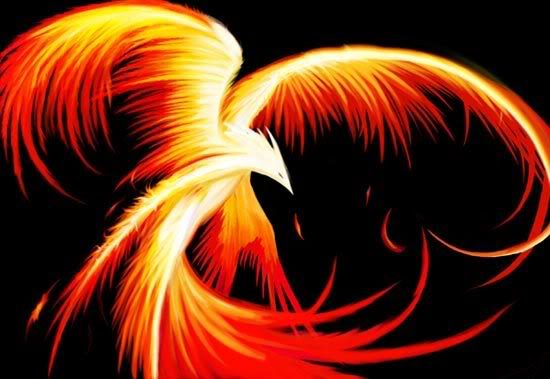
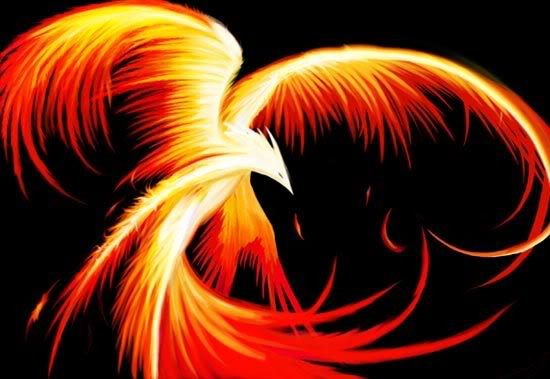
The Phoenix represents: rebirth, reincarnation, new beginnings, courage, adaptation, high virtue, grace, power, prosperity, strength, peace, purity and life.
Element: Fire
Planet: Sun
The phoenix is a mythical, sacred fire bird that can be found in the mythologies of the Arabian, Persians, Greeks, Romans, Egyptians, Chinese, Turks, and Indians.
It is described as a bird with a colorful plumage and a tail of gold and scarlet (or purple, blue, and green according to some legends). It has a 500 to 1000 year life-cycle, near the end of which it builds itself a nest of twigs that then ignites; both nest and bird burn fiercely and are reduced to ashes, from which a new, young phoenix or phoenix egg arises, reborn anew to live again. The new phoenix is destined to live as long as its old self.
Greek: The Greeks believed that the phoenix lived in Arabia, in a cool well. At dawn each morning, it sang a beautiful song, so beautiful that the Sun god would stop his chariot to listen. The Phoenix is a unique bird; there may only exist one at a time, which makes it a solitary bird. It does not reproduce, which adds to its loneliness, as only its death will bring on another of its race. When it feels its end approaching (between 500 and 1461 years, depending on the legend), it builds a nest with the finest aromatic woods, sets it on fire, and is consumed by its own flames. From the pile of ashes, a new phoenix arises, young and powerful. It then embalms the ashes of its predecessor in an egg of myrrh, and flies to the city of the sun, Heliopolis, where it deposits the egg on the altar of the Sun god.
Egyptian: The Bennu was known as the legendary phoenix to the Greeks. Herodotus, the Greek historian, says the following about the Benni:
“Another sacred bird is the phoenix; I have not seen a phoenix myself, except in paintings, for it is very rare and only visits the country (so they say at Heliopolis) only at intervals of five hundred years, on the occasion of the death of the parent bird.”
Herodotus goes on to record that the Bennu bird came from Arabia every 500 years carrying his father’s body embalmed in an egg of myrrh. This Arabian bird however, was said to resemble an eagle with brilliant gold and red plumage. Before the phoenix died it built a nest of incense twigs and laid down in it and died. From its body a small worm emerged that the sun’s heat transformed into the new phoenix.
Another story says that the phoenix rose again from the burnt and decomposing remains of his old body and took these to Heliopolis, where he burned them.
Chinese: The Fenghuang has very positive connotations. It is a symbol of high virtue and grace. The Fenghuang also symbolizes the union of yin and yang. Shan Hai Jing’s 1st chapter “Nanshang Jing” records each part of Fenghuang’s body as symbolizing a word: the head represents virtue, the wing represents duty, the back represents propriety, the abdomen says belief and the chest represents mercy.
It symbolized the Empress, usually in a pairing with a dragon (the dragon representing the Emperor), and only the Empress could wear the phoenix symbol. The phoenix represented power sent from the heavens to the Empress.
A common depiction of Fenghuang was of it attacking snakes with its talons and its wings spread. Fenghuang is said to be made up of the beak of a rooster, the face of a swallow, the forehead of a fowl, the neck of a snake, the breast of a goose, the back of a tortoise, the hindquarters of a stag and the tail of a fish.[1] Today, however, it is often described as a composite of many birds including the head of a golden pheasant, the body of a mandarin duck, the tail of a peacock, the legs of a crane, the mouth of a parrot, and the wings of a swallow.
Its body symbolizes the six celestial bodies: The head is the sky, the eyes are the sun, the back is the moon, the wings are the wind, the feet are the earth, and the tail is the planets. Its feathers contain the five fundamental colors: black, white, red, blue and yellow. It is also sometimes depicted as having three legs. It is believed that phoenix only appear in areas or places that are blessed with utmost peace and prosperity or happiness
In ancient and modern Chinese culture, they can often be found in the decorations for weddings or royalty, along with dragons. This is because the Chinese considered the dragon and phoenix symbolic of blissful relations between husband and wife, another common yin and yang metaphor.
Japan: Hou-ou, Ho-o, Hoo-oo. In Japan, as earlier in China, the mythical phoenix was adopted as a symbol of the Imperial household, particularly the Empress. This mythical bird represents fire, the sun, justice, obedience, fidelity, and the southern star constellations.
Arabian: The Arabian phoenix was as large as an eagle with purple and gold plumage. The phoenix was said to live between 500 and 12,994 years. Only one phoenix existed at a time. When it was time to die, it built a nest of boughs and spices, set it on fire and incinerated itself. A new phoenix was reborn out of the ashes. The phoenix is associated with the sun, growth, rejuvenation and rebirth. It represents the capacity of life to persevere, but at the same time signifies inevitable death.
 Ravenhawks' Magazine Magick for Mind Body and Soul